
How to Plan Staff Transportation Routes in Dubai
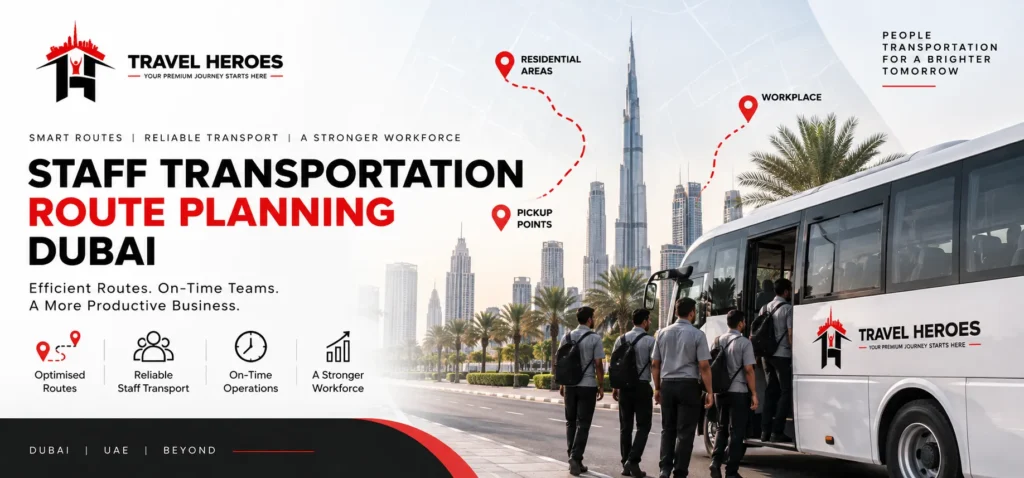
Staff transportation route planning in Dubai starts with employee locations, shift timings, workplace reporting times and passenger numbers.
The goal is to create practical pickup routes while choosing a vehicle that matches the number of employees travelling on each movement.
For recurring employee transport, companies can explore our Staff Transportation Service Dubai.
This guide explains how to organise pickup points, divide employees into routes, manage shifts and avoid common route-planning problems.
What Is Staff Transportation Route Planning?
Staff transportation route planning is the process of deciding where employees will be picked up, when they will travel and which vehicle will serve each route.
A good route connects employee pickup areas with the workplace without creating unnecessary stops or excessive travel.
The main information required is:
- Employee count
- Employee locations
- Workplace location
- Shift timings
- Reporting time
- Working days
- Vehicle requirement
Route planning should come before vehicle selection.
What Information Do You Need Before Planning a Staff Route?
Start with accurate employee and workplace information.
Without this data, it is difficult to decide how many routes or vehicles are required.
Prepare:
Employee Information
- Total number of employees
- Residential areas
- Employees in each area
- Shift assigned to each employee
- Working days
Workplace Information
- Workplace location
- Reporting time
- Shift start time
- Shift finish time
- Workplace access requirements
Transportation Information
- Proposed pickup areas
- Number of routes
- Approximate passenger count per route
- Required start date
Once this information is available, the routes can be planned more logically.
How to Plan Staff Transportation Routes in Dubai
The simplest approach is to group employees by location and shift before deciding the number of vehicles.
Follow these steps.
1. Create a List of Employee Pickup Areas
Start by listing where employees are travelling from.
You do not necessarily need an individual pickup point for every employee.
For example:
| Employee Area | Employees | Shift |
|---|---|---|
| Area A | 8 | Morning |
| Area B | 12 | Morning |
| Area C | 16 | Morning |
| Area D | 9 | Evening |
| Area E | 18 | Evening |
This gives you a basic picture of where demand exists.
2. Group Employees by Nearby Areas
Employees living close to each other can often use shared pickup points.
This can reduce unnecessary stops and make the route easier to manage.
For example:
Route A
Area A → Area B → Workplace
Route B
Area C → Workplace
Avoid sending one vehicle across several distant areas only because seats are available.
3. Separate Employees by Shift
Different shift times should usually be planned as different movements.
A morning route may not work for employees starting several hours later.
Create separate lists for:
- Morning shift
- Afternoon shift
- Evening shift
- Night shift
Then calculate the passenger requirement for each movement.
Companies with complex shift requirements can discuss them through our Staff Transportation Service Dubai.
4. Start With the Required Workplace Arrival Time
Plan backwards from when employees need to arrive.
If a shift begins at 8:00 AM, decide the required workplace arrival time first.
Then calculate:
Workplace arrival → travel time → intermediate pickups → first pickup
Consider:
- Number of stops
- Boarding time
- Route distance
- Expected road conditions
- Workplace entry time
Do not create a schedule with no time margin.
5. Reduce Unnecessary Pickup Stops
More stops do not always mean better transportation.
Too many individual pickups can increase journey time for everyone.
A better approach can be to create practical shared pickup points for employees living in the same area.
Pickup locations should be:
- Easy to identify
- Practical for employees
- Suitable for the vehicle
- Consistent from day to day
6. Calculate Passengers Per Route
Do not choose a vehicle using the company’s total employee count.
Calculate how many people travel on each route and each shift.
For example, a company with 80 employees might have:
| Route | Employees |
|---|---|
| Morning Route A | 18 |
| Morning Route B | 32 |
| Evening Route A | 12 |
| Evening Route B | 18 |
These routes do not all require the same vehicle.
7. Choose the Vehicle After the Route Is Planned
Vehicle selection should match the passenger requirement for each movement.
Travel Heroes’ Dubai transportation fleet includes different categories for different group sizes.
| Approximate Requirement | Vehicle Category |
|---|---|
| Small team | Passenger van |
| Around 18–22 passengers | Premium Minibus |
| Around 30–35 passengers | Mid-Size Bus or Coach |
| Around 50 passengers | Full-Size Coach |
For around 18–22 employees, see our Premium Minibuses Dubai.
For around 30–35 employees, explore Mid-Size Buses & Coaches Dubai.
For larger workforce movements, compare Full-Size Buses & Luxury Coaches Dubai.
8. Create a Clear Pickup Schedule
Each route should have one simple schedule.
For example:
Route A
6:35 AM — Pickup Point 1
6:50 AM — Pickup Point 2
7:10 AM — Pickup Point 3
7:45 AM — Workplace arrival
Employees should know:
- Pickup point
- Pickup time
- Vehicle or route
- Workplace destination
- Return schedule
Clear information reduces daily confusion.
When Should One Staff Route Be Split Into Two?
Split a route when combining employees creates excessive distance, too many stops or an unsuitable passenger load.
One vehicle is not always more efficient than two shorter routes.
Consider splitting when:
- Pickup areas are far apart
- The route repeatedly takes too long
- Too many stops are required
- Employees have different shift times
- Passenger numbers exceed the vehicle category
- One part of the route causes repeated delays
A shorter route may sometimes improve the overall transport plan.
Example
Imagine 35 employees live across four areas.
Option 1
One bus collects everyone from all four areas.
This may create a long route.
Option 2
Route A: 17 employees from two nearby areas
Route B: 18 employees from two other nearby areas
The correct setup depends on the actual locations and operating schedule.
Staff Pickup Point Planning Tips
Good pickup points should be simple for both employees and vehicles.
Keep these principles in mind.
Use Recognisable Locations
Employees should be able to identify the pickup location easily.
Avoid vague instructions such as:
“near the main road”
Use a clearly agreed location.
Keep Pickup Points Consistent
Changing locations frequently can create confusion.
Use the same pickup point unless operational requirements change.
Avoid Too Many Stops
One pickup for every employee can make a route inefficient.
Where practical, group nearby employees.
Set a Clear Departure Time
The route needs a defined departure schedule.
Employees should know when the vehicle is expected to leave the pickup point.
Staff Bus, Minibus or Van: Which Route Needs Which Vehicle?
The right vehicle depends on the number of employees using each route.
A smaller route does not need the same bus as a large workforce movement.
Passenger Van
Suitable for smaller staff groups.
Premium Minibus
Useful when approximately 18–22 employees need to travel together.
Mid-Size Bus
Suitable for larger staff routes around the 30–35 passenger category.
Full-Size Coach
Consider this category when a large group needs substantially more capacity.
For broader vehicle options, visit our Bus Rental Dubai page.
Common Staff Route Planning Problems and Solutions
Most problems can be traced back to pickup locations, timings or capacity planning.
| Problem | Practical Solution |
|---|---|
| Route is too long | Reduce stops or split the route |
| Employees arrive late | Review pickup times |
| Too many pickup locations | Group nearby employees |
| Bus is too large | Move to a smaller vehicle |
| Vehicle is always full | Review passenger numbers |
| Shift changes cause confusion | Maintain separate shift schedules |
| Employees miss pickups | Use fixed times and locations |
| Passenger count keeps changing | Review employee lists regularly |
Problem: One Route Takes Much Longer Than Others
One route may include too many distant pickup areas.
Solution: Review whether the route should be divided geographically.
Problem: Employees Keep Arriving Late
The schedule may not include enough travel or boarding time.
Solution: Work backwards from the required workplace arrival time and adjust pickups.
Problem: Vehicle Capacity No Longer Matches the Route
Employee numbers can change over time.
Solution: Review the passenger count and compare the appropriate Travel Heroes fleet options.
Problem: Different Shifts Are Using the Same Route Plan
A route designed for one shift may not suit another.
Solution: Build separate route plans where reporting times or passenger locations differ.
What Affects Staff Transportation Route Cost?
Staff transportation cost depends on the complete operating requirement.
Two routes with the same passenger count can have different requirements.
Important factors include:
- Vehicle category
- Number of routes
- Travel distance
- Number of pickup points
- Number of shifts
- Working days
- Journey duration
- Waiting time
- Additional stops
- Vehicle availability
For recurring employee transportation, provide the complete operating schedule when requesting a quotation.
Staff Transportation Route Planning Example
Suppose a business has 75 employees working two shifts.
Employees live across five different areas.
Instead of choosing one bus based on the total workforce, divide the requirement.
| Movement | Employees | Possible Category |
|---|---|---|
| Morning Route A | 20 | Premium Minibus |
| Morning Route B | 32 | Mid-Size Bus |
| Evening Route A | 10 | Smaller Vehicle |
| Evening Route B | 13 | Smaller Vehicle |
The key question is not:
“How many employees does the company have?”
The better question is:
“How many employees travel on each route at the same time?”
That determines the actual transport requirement.
How Often Should Staff Routes Be Reviewed?
Review routes whenever employee numbers, shifts or pickup locations change.
A monthly or periodic review can also identify routes that are no longer efficient.
Review the plan when:
- Employees join
- Employees leave
- Shift timings change
- Workplace changes
- Accommodation areas change
- Routes become regularly delayed
- Vehicles are consistently under capacity
- Vehicles regularly reach capacity
Staff routes should reflect the current workforce.
Staff Transportation vs Corporate Shuttle Transportation
Staff transportation mainly focuses on recurring employee pickup and drop-off movements.
Corporate transportation can cover broader company travel such as meetings, business guests, delegations and corporate events.
For employee commuting, visit Staff Transportation Service Dubai.
For wider business transportation, explore our Corporate Transportation Services Dubai.
Staff Transportation Route Planning Checklist
Before requesting a staff transportation plan, prepare:
Employee Details
- Total employee count
- Employees per shift
- Residential areas
- Employees per pickup area
Workplace Details
- Workplace location
- Reporting time
- Shift start time
- Shift end time
Route Details
- Pickup points
- Number of stops
- Approximate journey
- Required arrival time
- Return requirement
Operating Details
- Working days
- Proposed start date
- Number of shifts
- Estimated routes
Vehicle Details
- Passengers per route
- Preferred category if known
- Required capacity
Frequently Asked Questions
How do you plan a staff transportation route in Dubai?
Start by grouping employees according to location and shift.
Then define pickup points, required workplace arrival time, passenger numbers and suitable vehicle capacity.
How many pickup points should a staff bus have?
There is no fixed number of pickup points that suits every route.
Use enough stops to serve employees practically without making the route unnecessarily long.
Should employees receive door-to-door staff transportation?
It depends on the transportation arrangement.
For larger employee groups, shared pickup points can often make route planning simpler than individual pickups.
What vehicle is suitable for 20 employees?
A premium minibus category may be suitable for around 18–22 passengers.
See our Premium Minibuses Dubai page for this group size.
What size bus is suitable for 30 employees?
A mid-size 30–35 seater category may be worth considering.
Passenger numbers and route requirements should still be confirmed before selecting the vehicle.
Explore our Mid-Size Buses & Coaches Dubai.
What information is needed for a staff transportation quote?
Provide employee numbers, pickup areas, workplace, shifts, working days, reporting times and proposed start date.
The complete operating requirement helps determine the suitable route and vehicle.
Plan Staff Transportation Routes With Travel Heroes
Effective staff transportation route planning in Dubai starts with employee locations, shift timings, practical pickup points and the right vehicle capacity.
Travel Heroes can review your recurring workforce transportation requirements and help identify an appropriate vehicle and route structure.
Explore our Staff Transportation Service Dubai or contact Travel Heroes for a quotation.